 Textura: "Alice Shields' White Heron Dance [is] totally captivating... daringly programmatic... a standout. Currents provides a magnificent survey of the electroacoustic field..." — TEXTURA, MARCH 2019
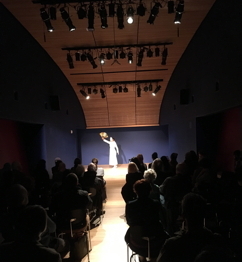 TheaterScene.net: Review of White Heron Dance, with fixed audio by Alice Shields, dance by Mayo Miwa, and video by Tom Barratt, at the 2017 New York City Electroacoustic Music Festival: "...universal grandeur, paradoxes of anguish and ecstacy, loss and regeneration, divinity made manifest..." — JEAN BALLARD TEREPKA, THEATERSCENE.NET
 AllMusic.com: "It is startling that composer Alice Shields has been on the electronic music beat for more than 35 years and yet, the Albany Records release Shenandoah: 3 Electronic Works is only the second full-length release from her in that time...Dust is the most immediately satisfying — its constantly changing metrical pulse and blend of textures easily keeps one's attention...The title track, Shenandoah, was composed in response to the 9/11 attacks, but do not look here for something akin to what John Adams does in On the Transmigration of Souls. Rather than ruminate over the depth and horror of this great tragedy, Shields presents in Shenandoah an affirmation of life and puts forth a tastefully low-key philosophical perspective on it...Shenandoah may well appeal equally to younger listeners who are into electronics either from a hip-hop or an industrial noise perspective." — UNCLE DAVE LEWIS, ALLMUSIC.COM
 Fanfare: "Kyrielle [(on "Stolen Gold," Albany Records, TROY1305)] is another rather unusual pairing of computer and violin because it includes sounds of a church organ to evoke the ambience of worship with Gregorian chant. A Kyrie asks God for mercy. Kyrielle is a feminine version that implores mercy from a feminine deity or saint, possibly the Virgin Mary. Alice Shields uses chants attributed to Gregory the Great, who was pope from 590 to 604, but she surrounds each with varied fragments and ornaments." — MARIA NOCKIN, FANFARE MAGAZINE
 ArkivMusic.com: "Fantastic violin and electronic elements [on Kyrielle, on "Stolen Gold," Albany Records, TROY1305]...a great find...beautiful and new and really worth a listen!" — R. OLSEN, ARKIVMUSIC.COM
Albany Records: "Violinist Airi Yoshioka's curiosity in the electro-acoustic medium led her to commission works from five composers — part of the seven breathtaking works [including Alice Shields' Kyrielle,] that are all given their world-premiere performances on this recording [("Stolen Gold," Albany Records, TROY1305)]." — ALBANY RECORDS
New Music Box: "Of all the pieces in this month's Soundtracks that incorporate to a greater or lesser degree references to a musical "Other," none is so wholly representative of a single tradition as Alice Shields' Komachi at Sekidera. Shields has been heavily involved with Indian music and dance during the past decade, but here she has set the words of a Noh play for soprano, alto flute, and koto in a style that sounds (to my semi-trained ears) thoroughly Japanese." — JENNY UNDERCOFLER, NEWMUSICBOX'S 'SOUNDTRACKS'
"Eight For the Vanguard: Hallwalls debuts eight new compositions for soloists"
ArtVoice: "Composer Alice Shields, influenced in her wide-ranging music by classical Indian music and dance, wrote her work River of Memory, which includes computer generated sounds, for Monique Buzzarté, known as a champion of women's music. Shields explains, "River of Memory is a meditation and reflection of memories in sound. The tempo is slow, like calm, deep waves flowing between minor and major tonalities, with little crests in major tonality, which soon subside into the next pool of mixed feelings." " — JAN JEZIORO, ARTVOICE)
CDEMusic.org: "Alice Shields' electronic music is too rarely heard. This CD containing three compositions - Vegetable Karma (1999), Dust (2002), and Shenandoah (2001) - is a welcome addition to the literature.
"In general, her music projects a transcultural take on the world, combining, for example, east and west through the haunting sounds of an Indian raga with bursts of hip-hop samples, or low sounds articulated with a Tibetan trumpet. She visited the Shenandoah Valley in Virginia shortly after the 9/11 attacks in 2001 and interviewed recent immigrants, often quoting their music in a pattern that moves from voice to musical excerpt. And the music, like the voices, comes from around the world." — CDEMUSIC.ORG
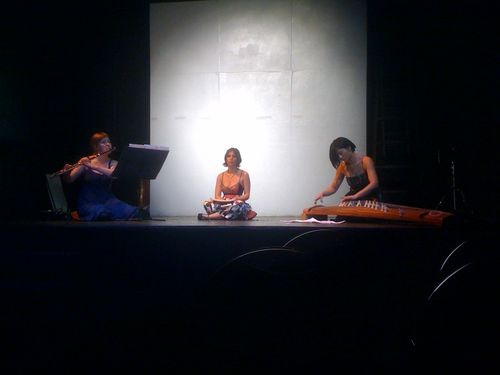
Night After Night blog: "What you see above is [Amelia] Lukas, brilliant mezzo soprano Laurie Rubin and koto player Asami Tamura during their performance of Alice Shields's lovely Komachi at Sekidera." (Photo by Steve Smith, from his Night After Night blog)
NeoLit Ensemble presents Komachi at Sekidera at The Tank
The New York Times: "In Komachi at Sekidera, by Alice Shields, the duo was joined by Asami Tamura on koto. In a brief introduction Ms. Shields described the piece, based on a Noh play, as depicting a Japanese poet, legendary for her ravishing beauty, reflecting on losses endured because of advancing age.
"Ms. Shields wrote the piece, she said, to honor her mother, an artist afflicted with Alzheimer's disease. Seated on the floor, the trio offered a limpid, eloquent performance of this touching piece, which made effective use of Ms. Rubin's rich lower register." — STEVE SMITH, THE NEW YORK TIMES
Columbia-Princeton Electronic Music Center 1961-1973 (New World Records)
Contains Study for Voice and Tape and Dance Piece No. 3 by Alice Shields
Modisti.com: "This is an excellent and essential compilation of vintage first-generation electronic music from one of the most well-known electronic music studios." — MODISTI.COM
Restless Spirits (Koch International Classics)
Contains Komachi at Sekidera by Alice Shields
Classics Today: "...an interesting piece...The sound, from New York City's Town Hall, maintains an appropriate chamber-music ambience while giving remarkable presence to the instruments and voice." — CLASSICS TODAY
CRISEYDE at the Feminist Theory and Music Conference UNC Greensboro
Associated Content: "...the Feminist Theory and Music Conference 2009, hosted by the University of North Carolina, Greensboro, had an eclectic mix of poignant new music from living female composers. This concert, as well as others following throughout the week in both lecture settings and concert halls, gave the opportunity for many talented contemporary composers to have their musical voices heard... The final highlight of the program was the premier of legendary composer Alice Shields' operatic work, Criseyde, which the composer describes as a feminist reconstruction of Chaucer's tale, Troilis and Criseyde. The opera Criseyde is truly a masterful work demonstrating the musical maturity of the composer through its intricacies and depth. Orchestrated for small vocal ensemble, piano, and cello, Criseyde involves the vocalists in a moving dance with the cello, performed beautifully by the performers." — SABRINA YOUNG, ASSOCIATED CONTENT on Criseyde
American Operas, Sifted and Sampled
The New York Times: "Female historical figures were also explored on Sunday with Alice Shield's Criseyde, a feminist interpretation of Chaucer's Troilus and Criseyde. Nancy Dean's libretto offers a rare chance to hear Middle English sung... The melodic development and ornamentation of the intense, richly scored work reflect Ms. Shields' lengthy study of classical Indian raga." — VIVIEN SCHWEITZER, THE NEW YORK TIMES on the New York City Opera VOX performance of Criseyde
Eight New Works, Newly Unwrapped
The New York Times: "Meet the Composer invited eight performers to choose a composer and commission a work; then it presented the eight scores back to back on Wednesday evening at Symphony Space. The results, the awkwardly named 'New Music for Soloist Champions,' were perhaps inevitably mixed, but you could not have asked for a more stylistically varied program.
Monique Buzzarté, a trombonist, is also a composer, but instead of commissioning herself she solicited The River of Memory from Alice Shields. Ms. Shields provided a lush, ambient electronic work in which major and minor chords melt into one another, and chimes, bird song and insect sounds periodically peek through. Wrapped in all this is a plaintive trombone line, which Ms. Buzzarté played from the back of the hall." — ALLAN KOZINN, THE NEW YORK TIMES on The River of Memory
The New York Times: "Mass for the Dead nearly raised them on Sunday night. This electronic ghost story, given its world premiere by the American Chamber Opera Company, blends Gregorian chant, Monteverdi arias, Latin recitation and 20th-century electronic soundscapes into a paganistic barrage. With robed figures whirling across a candlelit altar, the proceedings took on the aspect of a Black Mass. It's a reasonable guess that no spookier piece has been heard in New York this year." — ALEX ROSS, THE NEW YORK TIMES on the opera Mass for the Dead
Tellus: "The kyrie in Alice Shields' Mass is so unexpected it's almost shocking in the context of avantgarde." — from 'Continuo's Weblog / Reassessed aural delicacies'
on "Voices" from the opera Mass for the Dead, recorded on Tellus: The Audio Cassette Magazine #22: FALSE PHONEMES
SRUTI (India): "awesome... so luxuriant yet eerily supernatural, it convulsed the senses. ...a startling extension of the consciousness of India, in an equally startling Western opera of the seen and unseen." — Nala Najan, SRUTI, "India's Premier Music and Dance Magazine" on the opera Mass for the Dead
Musical America: "...eerily evocative, transporting one to an other-worldly place where spiritualism and magic are interwoven. From the opening darkness to shrieks to distant cries in the wilderness, it holds the listener spellbound. Shields exudes integrity, originality, and courage." — Joan La Barbara, MUSICAL AMERICA on "Coyote" from the opera Shaman
The New York Times: "...well organized, and eerily effective." — Robert Palmer, THE NEW YORK TIMES on "Coyote" from the opera Shaman
The Splatter Effect: "...a full-blown electronic opera, based on Indian classical music, and yes, 'heavy metal rock.' The mystic feel of Indian music is all over the disk." — THE SPLATTER EFFECT on the opera Apocalypse
Contact (Montreal): "...one of the first electronic operas. This sensual/intellectual music requires more than one listening to begin grasping its force, its power of persuasion, and the beauty of its engaging rhythms, colors and textures. Highly recommended in a field that still has very few examples." — CONTACT (Montreal) on the opera Apocalypse
CDE Music: "a major work, with dramatic and powerful gestures." — CDEMUSIC (Electronic Music Foundation) on the opera Apocalypse
American Record Guide: "All very current— and very serious. Apocalypse is relentless." — AMERICAN RECORD GUIDE on the opera Apocalypse
Classical Music by Women: Apocalypse on Compact Disc
International League of Women Composers Journal: "Several CDs of more avant garde music have been added to my personal collection over the past few months. A most welcome addition has been Dr. Alice Shields's Apocalypse, released several months ago by CRI (CRI CD 647). Shields, one of the first women to work to work extensively in the electro-acoustic medium, in 1965 became Technical Instructor at the Columbia-Princeton Electronic Music Center and served as Vladimir Ussachevsky's personal technician and collaborator on several of his works. After receiving her doctorate in music composition from Columbia University in 1975, she became Associate Director of the Center, a position she held until 1982. In addition to her achievements in music composition, she is a poet and an opera singer of considerable skill and experience.
"Apocalypse is an electronic opera for live and recorded singers and is choreographed with movement patterns from the Hindu Bharata Natyam dance-drama. The CD recording features selections from the complete opera and contains the tape portion of the work, created with both MIDI and analog electronic music technology. In the live performance, the characters "The Woman," "The Seaweed" and "Chorus" are performed by Shields, a mezzo, and "Shiva" is performed by baritone Michael Willson — who sing along with their pre-recorded and electronically-manipulated voices on tape.
"Shields provides detailed descriptions of her self-written story in the recording's program notes, which I will paraphrase. The central character in the opera is "The Woman" who travels from conception, to birth, to her meeting and initiation by the Goddess whom the composer names "The Seaweed." The Seaweed teaches the Woman empathy, emotional attachment, and reverence for all life, utilizing phrases based on the Bhagavad Gita. After taking on herself the persona of the Goddess, the Woman prepares to meet the God, whom Shields names Shiva. In the opera Shiva represents the breaking of the illusion of separateness through the metaphor of sexuality, and the work culminates in the Woman's sexualized union with the God in a stylized enactment of the Tantrik maithuna, the love-making of Shiva and Shakti combining spirit and matter, mind and energy, asceticism and sensuality.
"The opera was begun in the summer of 1990 with the completion of the "Apocalypse Song" which later became the centerpiece of the entire drama. Shields stresses the influence of multiculturalism in her work, and the opera utilizes texts in English, classical Greek, Gaelic, and Sanskrit. The recording is an interesting one with fine balancing of all vocal and electronic parts. I was impressed with Apocalypse, not only with its intriguing sounds, continually changing musical characters, and unique vocal manipulations but also with Shields powerful and beautiful voice. As a composer of electronic opera myself, I found Apocalypse to be of great importance to me as an example of superior work." — ELIZABETH HINKLE-TURNER, INTERNATIONAL LEAGUE OF WOMEN COMPOSERS JOURNAL
American Record Guide: "... remarkable rigor and variety. Taking its text from the Egyptian Book of the Dead wherein a dying soul appeals to Osiris, Ani is a spooky ride, the aural equivalent to Kenneth Anger's satanic cult fim, Inauguration of the Pleasure Dome. Its ending, a series of altered moans, is without cliche and chilling to the bone." — Ellis, AMERICAN RECORD GUIDE on the electronic piece The Transformation of Ani
Fanfare: "... a highly responsive background for a chanted text from the Egyptian Book of the Dead;
the spatial drama of the piece seems a genuine extension of electronic possibilities." — Alex Ross, FANFARE on the electronic piece The Transformation of Ani
The Tentacle: "After hearing Igor Stravinsky's Movements, Alice Shields's Transformation of Ani, Sun Ra's The Magic City, or any among a mile-long list of creative music, most mainstream music sounds laughable, irrelevant, and emotionally feeble." — Christopher DeLaurenti, THE TENTACLE on the electronic piece The Transformation of Ani
The New York Times: "... Interspersed with her flat, halting words were strangled cries, abortive screams and fragmented voices calling from some unimaginable beyond. All extremely interesting and worth rehearing..." — THE NEW YORK TIMES on the electronic piece The Transformation of Ani
The Sonar Map: "In an operatic tour de force, Alice Shields embeds a reading from the Book of the Dead amidst a whirlwind of hair-raising sounds derived from her classically trained voice." — THE SONAR MAP, Playlist Archive on the electronic piece The Transformation of Ani
Ear Magazine: "...echoing beauty and sustain ring out of this hommage to Brahms." — EAR MAGAZINE on Rhapsody for Piano and Tape
 DUST
DUST
"Multi-cultural creative production"
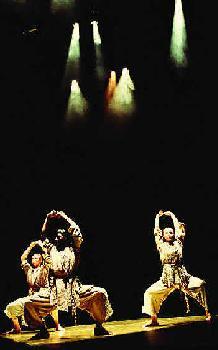
The Hindu (India): "This 30-minute work, with original music by Alice Shields, is the result of a three-year period of dialogue and experimentation between Anita Ratnam and Mark Taylor (Dance Alloy) on the kinetic and esthetic potentials of mixing traditional Bharatanatyam and contemporary post-modern movement forms. The music and movement images for Dust were drawn from the writings of Alexandra David Neel, a European Buddhist scholar who was one of the first Westerners to enter the forbidden city of Lhasa, Tibet as well as from photographs and sound sources of Tibetan landscape and culture...Anusha Subrahmanyam and L. Narendra Kumar and Andre Koslowski and Gwen Ritchie...bring alive the exciting blend of two cultures that reflect the ancient with the modern. Alice Shields, the music composer created the sound sources that included Tibetan trumpets, Tibetan ritual conch shells and Indian music."
Pittsburgh Post-Gazette: "...another major cultural collaboration with Dust, a work based on the writings and story of Alexandra David-Neel, a female explorer from the 1920s who was the first European to venture into the forbidden city of Lhasa in Tibet.
"Alice Shields' exotic electronic score, replete with Tibetan trumpets and an Indian singing voice, and Barbara Thompson's lighting design, with its overhead spots, a golden ring of light and a fragmented wash, added greatly to the overall mood....
"Mind-boggling art rises out of 'Mud'"
Associated Press, David Dishneau: "Guided by a naturalist, they dug deep into the morass to experience its essential weirdness: the carnivorous and gender-bending plants; the creatures equally at home on land and water; the sphagnum moss, ever dying on the bottom as it grows on top, forming a springy mat strong enough to dance on — lightly. ... "You walk in a particular manner so as not to sink. You keep moving in a particular tempo," Shields said. ... Her music mimics wetland birds and insects. It also incorporates spoken words from Hurd's text, including the key, repeated phrase, "Borders relax, shift, absorb."
Audiophile Audition: "Alice Shields's Komachi at Sekidera (based on a Japanese Noh play) is a fascinating exploration of the melismatic voice against the timbres of alto flute and koto." — Alex Morin, AUDIOPHILE AUDITION on the chamber piece Komachi at Sekidera
Alibi.com: "In her recital of works by Ades, Poulenc, Purcell, Bolcom, Shields, and Hoiby, the amazing soprano Dora Ohrenstein becomes the vocal equivalent of Meryl Streep, brilliantly meeting the challenge of portraying an extremely diverse and colorful cast of characters.
"Performing mainly in English, the singer begins with Thomas Ades' Life Story, set to what she describes as Tennessee Williams' "world weary, terribly knowing" poem of the same name. Ending with hints of death, Ohrenstein segues from Ades' jazz-tinged vocal line to the suicidal La Dame de Monte Carlo by Francis Poulenc and Jean Cocteau. If their woman ends by singing of falling head first into the sea, Henry Purcell's 17th century Bess of Bedlam, whose original vocal line is accompanied by a modern arrangement of electric guitar, accordion, and bass clarinet, manages to fall apart across a span of several centuries. A break from madness is offered via five songs from William Bolcom's I Will Breathe a Mountain, set to poems by five different female poets. Equally rewarding is Alice Shields' beautiful Komachi at Sekidera, to text adapted from a Noh play by Kanze Motkiyo Zeame."
Glen Falls Times (on Odyssey 2): "...imaginative and exploratory in its contrasts of comedy and tragedy...disturbing connotations...a horrifying power in the defilement of the paper woman."
Pollikoff's 'Music in Out Time' Presents a Madcap 'Archangel'
The New York Times: "Elsewhere, Valarie Lamouree sang, spoke and whistled, with the help of Judith Martin, oboist, and Ronald Anderson, trumpeter, in Alice Shields' Spring Music. ...Miss Shields Spring Music had moments of shattering sonority -- she is a promising young composer..." — THEODORE STRONGIN, THE NEW YORK TIMES